
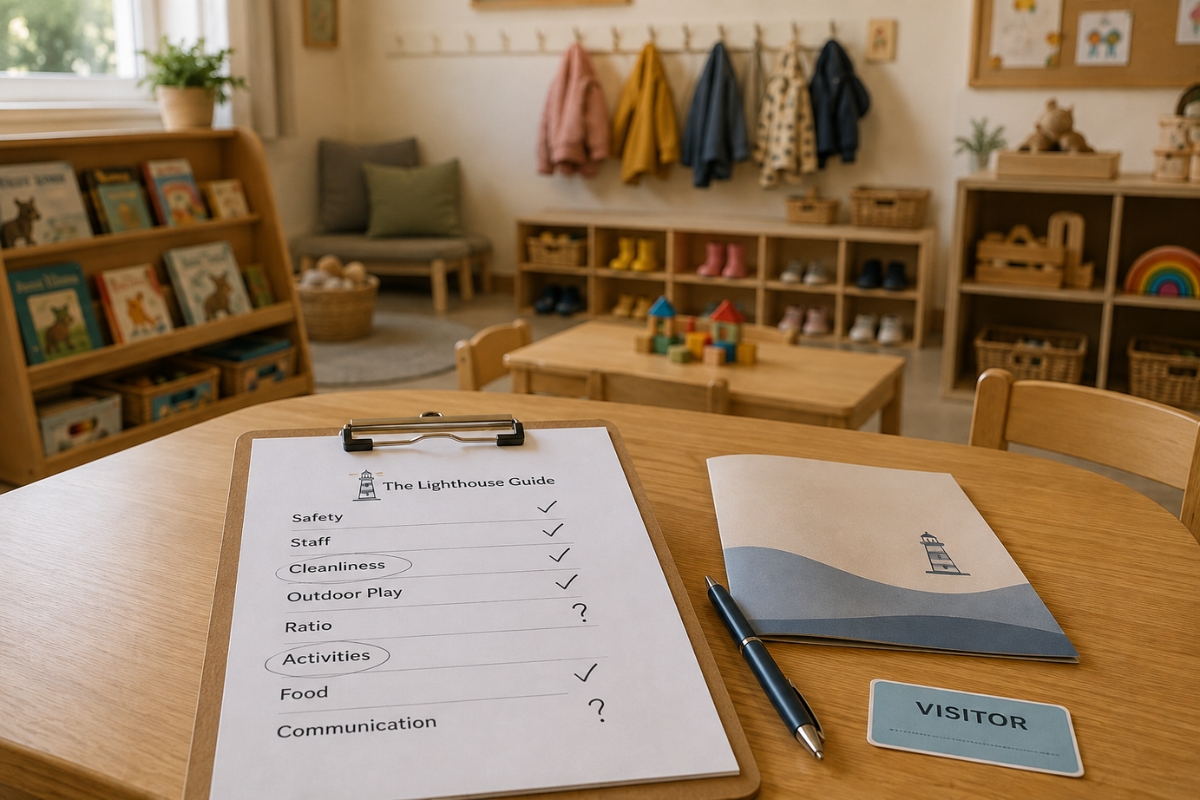
In Part 2 I made the case for nursery. In Part 3 I made the case against.
I still have not decided.
But I know what home offers, because I live in it. What I cannot judge is the other side. So I have to go and look.
The problem is that a nursery visit is not what people imagine. You do not sit in a toddler room for an hour and watch. You get a short tour, mostly walking, with a manager talking beside you. You look into rooms rather than stay in them. You see about four minutes of any room.
So this list is built around that. Three parts. What you can actually see in a short walk. What the children tell you. And what you have to ask, because you will never see it.
Two notes before the list
First, this only works if there are children in the building. If you visit during a holiday you will be shown empty rooms and a brochure, and you will learn nothing. In my case, some nurseries have already started their term and others are running summer sessions, so there are children to look at. If there are not, ask to come back another day.
Second, I know this list is long. It reads like it was written by a Karen. And honestly, that is fine. You are leaving your child with strangers. Being difficult is part of the job.
But you do not have to care about all of it. Pick the things that matter to you and let the rest go. I care about the brand of soap on the wall and the smell of the place. You will care about something else that other people find strange. That is normal.
What you can see on the tour
The room. How big is it, and how many children are inside? You can count them. Twenty toddlers in one large hall is a very different place from eight in a small room, whatever the number of adults.
The adults. Count them yourself instead of accepting the number you were told. Then look at what each one is actually doing.
Screens. Is there a television or a tablet in the toddler room? This is a bad sign even if it is switched off, because it is in the room for a reason. You will notice it immediately.
What is on the floor and shelves. Blocks, water trays, sand, books, balls, paint, climbing frames, dressing-up clothes. Or tables, chairs, worksheets and flashcards. This tells you what the day looks like without anyone having to describe it.
Whether the children can reach anything. If all the good material is on high shelves, the children are not using it. If it is at their height and slightly messy, they are.
The changing area. Look at it properly. Is it clean? Is there a sink next to it? Is there soap? Is it smelly, meaning nappies sit there for a long time, or are they removed immediately?
The bathroom. Small toilets and low sinks, or adult ones with a step. Clean or not. Soap brand.
The sleeping room. Is there one? How many beds, and how close together? Is it dark and quiet, or next to the noisy room? Or do the children sleep on mats in the same room where everything else happens? Again, the smell of it.
The outdoor space. Not whether it exists. Whether it is used. Worn grass, scratched equipment, toys left outside. That is a garden in daily use. Perfect grass and new equipment usually means it is there for photographs.
Where they eat. High chairs, small tables, or the same room they play in. Is it clean? Is it near the food?
General condition. Not how expensive it looks. Whether it is looked after. Are broken things fixed or left broken?
What the children tell you
This is the most useful part of a short visit, because you can read a room quickly.
Are the children busy? Doing something, moving around, interested in things? Or sitting, drifting, waiting?
Is anyone crying, and did an adult go to them?
Do the children move towards the adults, or around them?
Do they look at you when you walk in? Curiosity is a good sign. A room of toddlers who do not react at all is strange.
Are they all doing the same thing because they were told to, or different things because they chose to?
And the simplest question. Does the room feel busy and calm, or does it feel loud and out of control?
What you have to ask
None of this is visible on a tour. If you do not ask, you will not know.
Staffing
How many adults are with the toddlers between eleven and one, when lunch, nappies and staff breaks all happen at the same time?
Who covers when someone is on a break or off sick?
How many staff in this room left in the last twelve months?
How long has the main toddler teacher worked here?
His person
Who will be his key person?
Will she be the one who feeds him, changes him, settles him to sleep and greets him in the morning?
What happens if she leaves?
The first weeks
Can I come with him for a short visit before he starts?
Can he begin with short days and build up slowly?
What do you do if he is still very upset after a week?
The day
How long were the toddlers outside yesterday?
Is there one nap time for everyone, or is there flexibility if he is tired earlier?
What happens if he does not want to eat?
When things go wrong
What do you do when a toddler bites another child?
What is your policy on fever and vomiting, and when can he come back?
How are allergies recorded, and who knows about them?
Safety
Who can enter the building?
Who is allowed to collect him, and how do you check?
Who on each shift has paediatric first aid?
Where are medicines kept?
Vague answers here worry me far more than an old or shabby classroom.
What I am ignoring
The furniture. The uniform. The reception area. The Instagram account. The app that tells me nap 10:42, meal 11:13.
And the words on the door. Montessori, Reggio, Waldorf, bilingual, STEM. All of them can describe good practice, and none of them tell me what an eighteen-month-old actually experiences all day.
None of it is harmful. It just does not tell you anything.
And one thing I am against
The camera.
Many nurseries here offer a live camera so parents can watch the room from their phones, and they sell it as a feature.
I do not want it, for two reasons.
It puts your child’s privacy in the hands of every other parent in that room. Anyone can record it, take a screenshot and share it, and you will never know.
And more importantly, think about what wanting it means. You are handing over the most precious thing you have. That should go to a place you trust. If you trust them, you do not need to watch. If you feel you need to watch, then you have already decided something about that place, and you should listen to that instead of installing a camera.
A camera does not create good care. It only lets you see bad care more clearly.
That is the list. Now I have to go and use it.
I am not trying to find the best nursery. I am trying to find out whether any nursery near us is good enough to be better for him than staying at home.
Then the decision.